← Field journal · The thesis
Why grass is the most underrated technology on Earth
Power of Grass
We spend billions imagining machines that will one day pull carbon out of the sky and lock it away. We already have one. It's been running for hundreds of millions of years, it costs nothing, it powers itself, and it makes everything around it healthier as a side effect. It's grass.
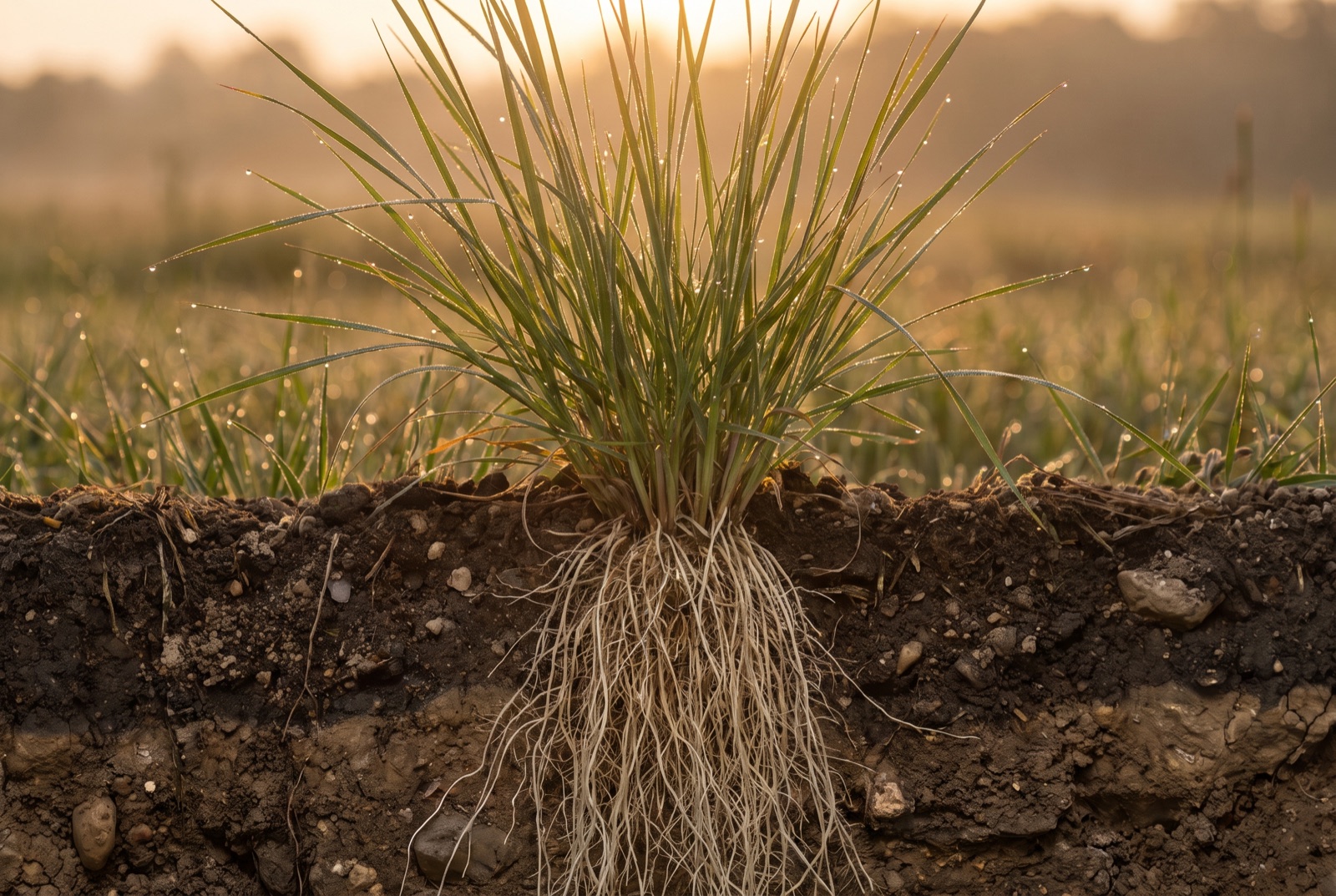
Here's the whole machine in one sentence: a blade of grass turns sunlight into sugar, sends that sugar down through its roots, and trades it to the life in the soil in exchange for the minerals it needs. That single exchange is the engine under everything we care about.
It builds soil
Roots don't just anchor a plant — they feed a city. A well-grown pasture pushes a huge share of the sugar it makes straight down into the ground, where fungi, bacteria, and earthworms turn it into stable organic matter. That organic matter is soil carbon. Building it isn't a sacrifice we make for the climate; it's the natural result of growing grass the way it wants to grow. The fastest, cheapest carbon capture we have isn't a machine. It's a pasture done right.
It manages water
Soil that's alive behaves like a sponge. Rain soaks in instead of running off. That does three things at once: it fills a reserve the land can draw on through a dry spell, it blunts the flood when the next big rain comes, and it filters the water clean before it ever reaches a creek. Dead, compacted dirt does the opposite — it sheds water, sends soil and nutrients downstream, and turns every heavy rain into a problem for someone below you.
It makes weather
This is the part almost no one talks about. A green, transpiring landscape breathes water vapor back into the air. That moisture seeds clouds and moves rainfall downwind. Living land doesn't just survive the water cycle — it participates in it. Bare, baked ground breaks the cycle; growing ground keeps it turning.
It feeds us — really feeds us
We can't eat grass. A cow can. A ruminant's gut is a fermentation vat that unlocks nutrition from grass that our own stomachs could never touch. When an animal built to eat grass eats grass grown in living soil, the food it becomes carries the minerals and fats our depleted, over-farmed soils stopped giving us directly. Food grown this way isn't just cleaner — it starts to close the nutritional gaps behind a lot of what ails us.
The catch
Every bit of this depends on good practice. Grass left neglected does little. Grass replaced by bare, sprayed, synthetic ground does less than nothing. The machine only runs when it's tended — grazed at the right time, rested long enough to recover, kept covered and alive. That's the work. It's not expensive and it's not complicated, but it does ask you to pay attention.
None of this needs a subsidy, a mandate, or anyone's permission. It needs people willing to do the practice and prove it works. That's what we're setting out to do — and to document, from the very first paddock.