← Field journal · Land & value
The number that should set the price of land
Power of Grass · August 2026
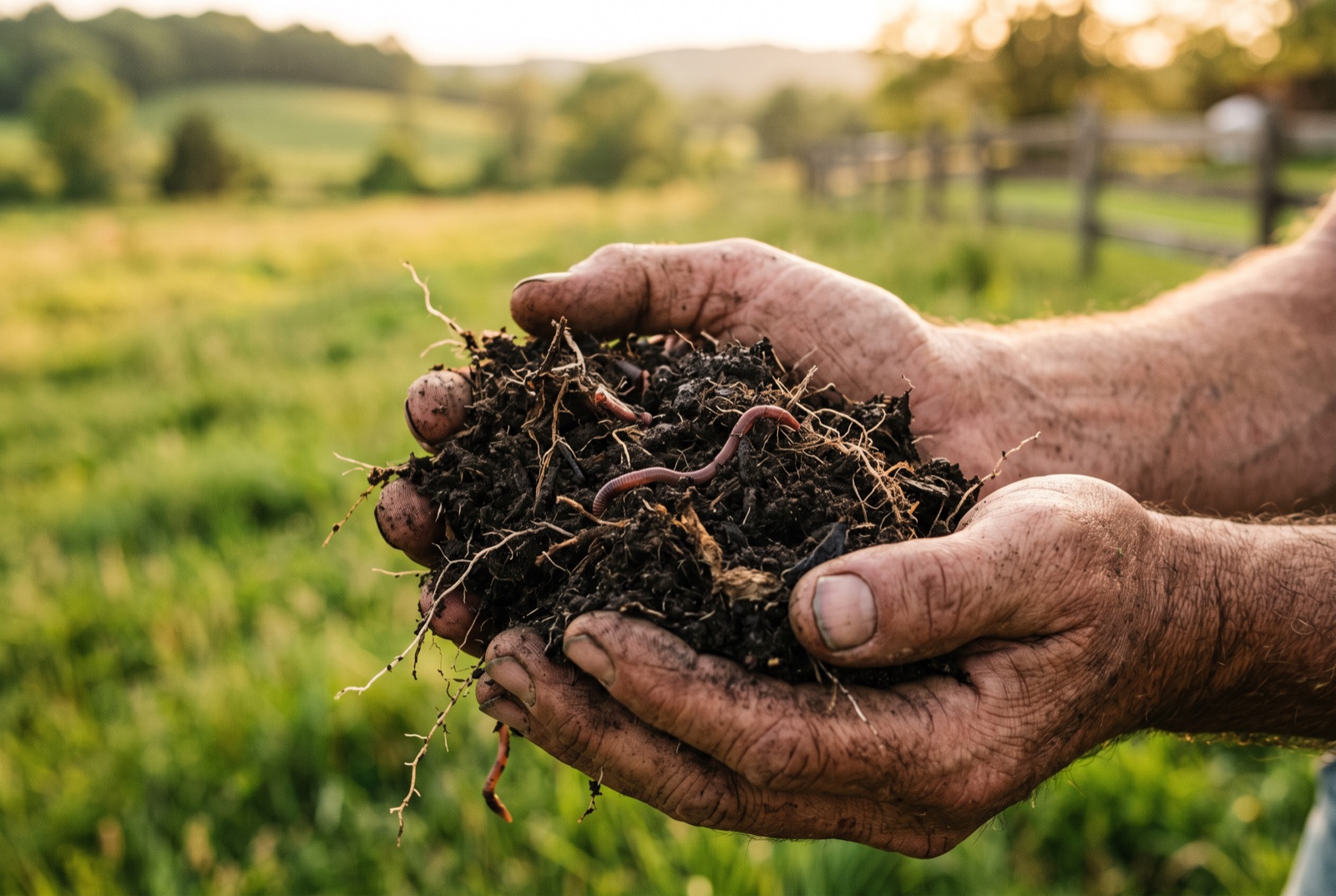
Walk into any land sale and you'll hear the same vocabulary. Acreage. Road frontage. Zoning. The house, the barn, the well. Comparables down the road. Not once — not on a single appraisal or listing — will anyone ask the question that actually decides whether that ground will still be productive in fifty years: how alive is the soil?
A field with rich, biologically active soil and a field that's been tilled and sprayed to exhaustion can sell for nearly the same price, as long as the acreage and the location match. One is an asset that compounds. The other is a liability wearing a nice fence. And the market can't tell them apart — because it's measuring everything except the thing that matters most.
There's a single number that captures most of the difference, and it's cheap to measure: soil organic matter.
Organic matter is the balance sheet
Organic matter is the living, and formerly living, fraction of soil — roots, microbes, fungi, and the carbon-rich residue of everything that ever grew and died there. It's usually just a few percent by weight, and moving it even one point is a major event, because almost everything that makes land valuable scales with it:
- Water. A single percentage point of organic matter lets an acre hold tens of thousands more gallons of water — drought insurance in July and flood insurance in spring. Living soil drinks the rain instead of shedding it.
- Fertility. Organic matter is the pantry: the reservoir that stores and slowly releases the nutrients a crop needs.
- Carbon. Building soil is the fastest, cheapest carbon storage we have — and unlike most climate spending, it pays the landowner back directly.
- Resilience. Good structure, deep roots, biology that buffers stress. The living field bends where the dead one breaks.
You can measure all of it for the price of a soil test. It's not a vibe. It's a number.
Living soil is cheaper to farm
Here's the part the balance sheet really misses: soil biology does work that farmers currently buy. A living soil is full of microbes and mycorrhizal fungi that unlock minerals and hand them to roots in a form the plant can use, fix nitrogen out of thin air, and cycle nutrients that would otherwise have to come out of a bag. Land with that biology intact needs fewer synthetic inputs — sometimes none — to grow the same crop. Every jug of chemistry and bag of fertilizer you don't have to buy is margin. A field that feeds itself out-earns a field on life support even at identical yield, because its cost of production is lower. Profitability isn't only about what comes off the land; it's about what you never had to pour onto it.
And it costs less to work
The savings don't stop at inputs. A perennial pasture regenerates itself after the herd moves through — no tilling, no re-seeding, no betting the season on a spring planting. A regenerative crop grown no-till skips pass after pass of heavy equipment. That's diesel, labor, seed, and machine wear that simply falls off the ledger — while the soil, left intact, stops eroding into the ditch. The tractor used to do the work; on living ground, the biology does it for free.
Depleted soil grows depleted food
And the output isn't just cheaper and tougher — it's better. A plant can only pass on the minerals it can pull from the ground, and it pulls most of them with the help of soil life; strip that biology out with tillage and chemistry and you're left with a plant grown on a narrow synthetic diet — big, fast, and increasingly hollow. The evidence keeps pointing the same way: food grown on depleted soil carries fewer of the minerals and compounds it's supposed to.
Then it climbs the food chain. An animal grazing living, diverse pasture eats that density and concentrates it — which is why grass-fed-and-finished meat and pastured eggs carry a richer nutritional profile than the feedlot version. Both halves of the plate, plant and animal, are only as nourishing as the soil beneath them. Food really can be medicine — but only when the ground is alive enough to make it.
So price the asset honestly
Add it up, and organic matter isn't a feel-good metric. It's the driver of profit (fewer inputs), lower operating cost (less tillage and seeding), resilience (water, carbon, drought, flood), and nutrition (mineral-dense food). Every one of those is real economic value — and today's price of land ignores all of it.
Now imagine it didn't. Imagine organic matter percentage showed up on the appraisal, in the lending terms, in the equity a landowner could borrow against. Overnight, building soil becomes building wealth — and mining it becomes visibly destroying your own balance sheet. Regeneration stops being something you do for your grandkids and becomes the obvious financial move this quarter. Good practice wouldn't need a moral argument. It would just be good business.
We already do this at small scale
This isn't as far-fetched as it sounds, because we already price living things when we can see them. A cared-for property with healthy landscaping sells for more than the neglected one beside it — curb appeal is just soil-and-plant health the market already knows how to read. That's the whole idea behind Big Grass Guy, our lawn app: score the living thing, and give people a reason to grow it well. Same mechanic as this — organic matter as value — shrunk to the size of a backyard. Scale it up to farmland and you change how a continent treats its ground.
None of this is ideology. It's accounting. We've just been keeping the books wrong — counting the barn and the road frontage, and leaving the most productive, most nourishing asset on the property off the ledger entirely. Put it back on. Price the soil, and the behavior follows the number.