← Field journal · The herd
Why South Poll, why here
Power of Grass
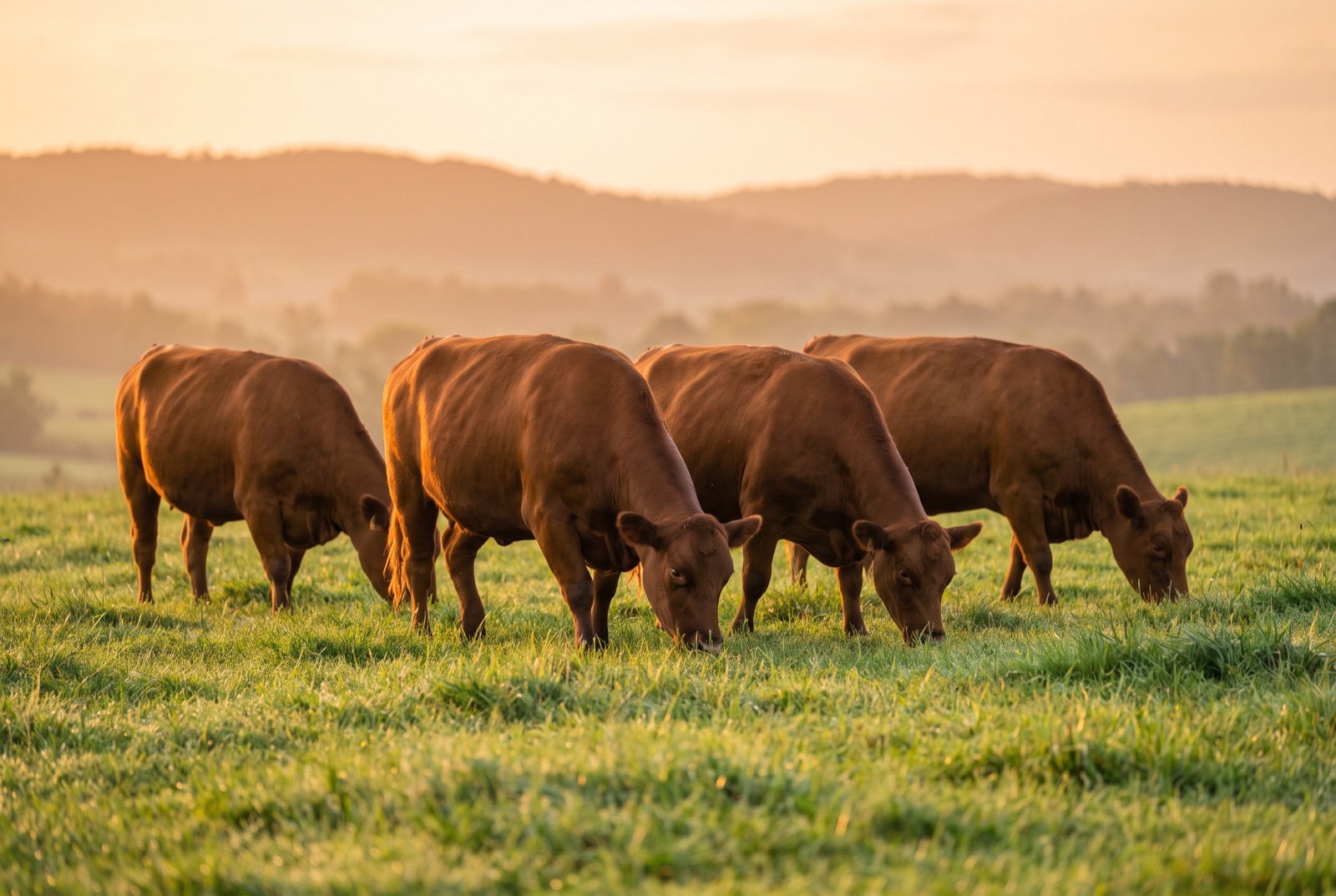
Pick the wrong animal and you spend every day fighting it — fighting its size, its temper, its appetite for damage. Pick the right one and it becomes a partner in the work instead of an obstacle to it. For the kind of farm we want to build, that animal is the South Poll.
Here's what most people don't realize: South Poll isn't some old heritage breed — it's a modern composite, built on purpose. Around 1989, Teddy Gentry (the bass player from the band Alabama) started crossing Red Poll, Senepol, Hereford, and Barzona on his farm in Alabama with a single goal: a moderate, gentle cow that could raise quality beef on grass alone in punishing heat. Nothing about the animal is an accident. Every trait was selected for — and they're the exact traits a regenerative grazier needs.
Carrying capacity is pounds, not head
Land doesn't carry a number of cows — it carries a weight of animal. A pasture that supports so many pounds of liveweight supports it whether that's a handful of big cows or more small ones. A mature South Poll is a moderate animal, right around a thousand pounds. Breeds like Charolais or Angus can be one and a half to two times that size. So on the very same ground, at the very same carrying capacity, you can run noticeably more South Poll head than you could big Continental cattle.
More animals, less damage
That's where it matters for the soil. A heavier animal drives more pressure down through every hoof — and that's the compaction that seals the ground and stops water from soaking in. Spread the same total weight across more, lighter animals and you get the good side of hooves — breaking the crust, pressing seed into contact, working litter down into the soil — without the deep compaction a two-thousand-pound animal leaves behind. More head also makes a tighter mob, which grazes and fertilizes a paddock more evenly. Same pounds on the land, easier on the land, and more of the herd effect that actually builds pasture.
Calm enough to run a flerd
Rotational grazing means contact — a lot of it. You're in with the animals nearly every day, moving fences, shifting the herd, reading their condition up close. A flighty, reactive breed makes that dangerous and exhausting. South Poll are famous for a genuinely docile temperament, and that calm opens a door most breeds can't: you can run a flerd — cattle, sheep, and sometimes goats grazing together as one group. Multi-species grazing eats a wider range of plants, breaks parasite cycles (a sheep's worm is a dead end in a cow, and the reverse), and pulls more food off the same acre. Calm cattle make that safe — for the other animals, and for the people working them.
A fertile, tidy animal that stacks
South Poll are efficient, fertile mothers — they breed back well and raise a good calf on grass, which is the whole ballgame in a low-input herd. And they're tidy. A moderate animal drops smaller, more scattered manure, and a following flock of poultry can work through it far more efficiently — scratching the pats apart, eating fly larvae and parasites, and spreading that fertility evenly across the paddock. Run the birds a few days behind the herd and you close a loop: less fly load, cleaner pasture, free fertilizer, and eggs or meat stacked on top of the beef.
It finishes on grass
The whole point is food grown from a living pasture, start to finish — grass-fed and grass-finished, no detour through a feedlot. A breed that fleshes well on forage alone makes that possible without fighting the animal's genetics the whole way. South Poll were selected to do exactly that.
The bison did this once
North America's deepest, richest soils were built by grazing animals — vast herds of bison bunched tight by predators, hammering a patch of prairie hard, then moving on and not returning until it had fully recovered. That pulse — graze hard, then rest long — fed the soil for thousands of years. The bison are gone, and the land lost its keystone grazer. Managed rotational grazing puts that pulse back, and a calm, moderate South Poll does the ecological work of the bison while respecting a fence and a property line. You get the healing without the wildness — and when you get a move wrong, you just fix it: shift the herd, rest the ground, no harm done.
One honest tradeoff
There's a real downside, and we won't pretend otherwise: a smaller animal hangs a smaller carcass — fewer pounds on the rail per head at slaughter. If your whole game is maximum weight per animal, this isn't your cow. But we think that's the wrong scoreboard. We're after pounds of good beef per acre, off grass, on land that gets healthier every year — not the biggest number per head bought with grain, chemicals, and compacted, lifeless soil. On that scoreboard, the South Poll wins.
A proven breed, south to north
South Poll were developed in the warm South, but the traits that make them great graziers — moderate frame, easy fleshing on forage, calm temperament, hardiness — travel with them into colder country. A moderate, easy-keeping animal that thrives on grass handles a hard winter more sensibly than a lot of the heavy Continental breeds people default to. Moving a proven animal onto new ground isn't a gamble; it's carrying a known-good tool somewhere it simply hasn't been used enough yet.
Being early with a proven-but-underused breed is its own kind of contribution. If we can prove it out in our own conditions — our soil, our winters, a grazing system built around it — we're not just building a farm. We're opening a door for the next grazier who's been waiting for someone to go first.