← Field journal · The ground
Building soil from rock
Power of Grass · September 2026
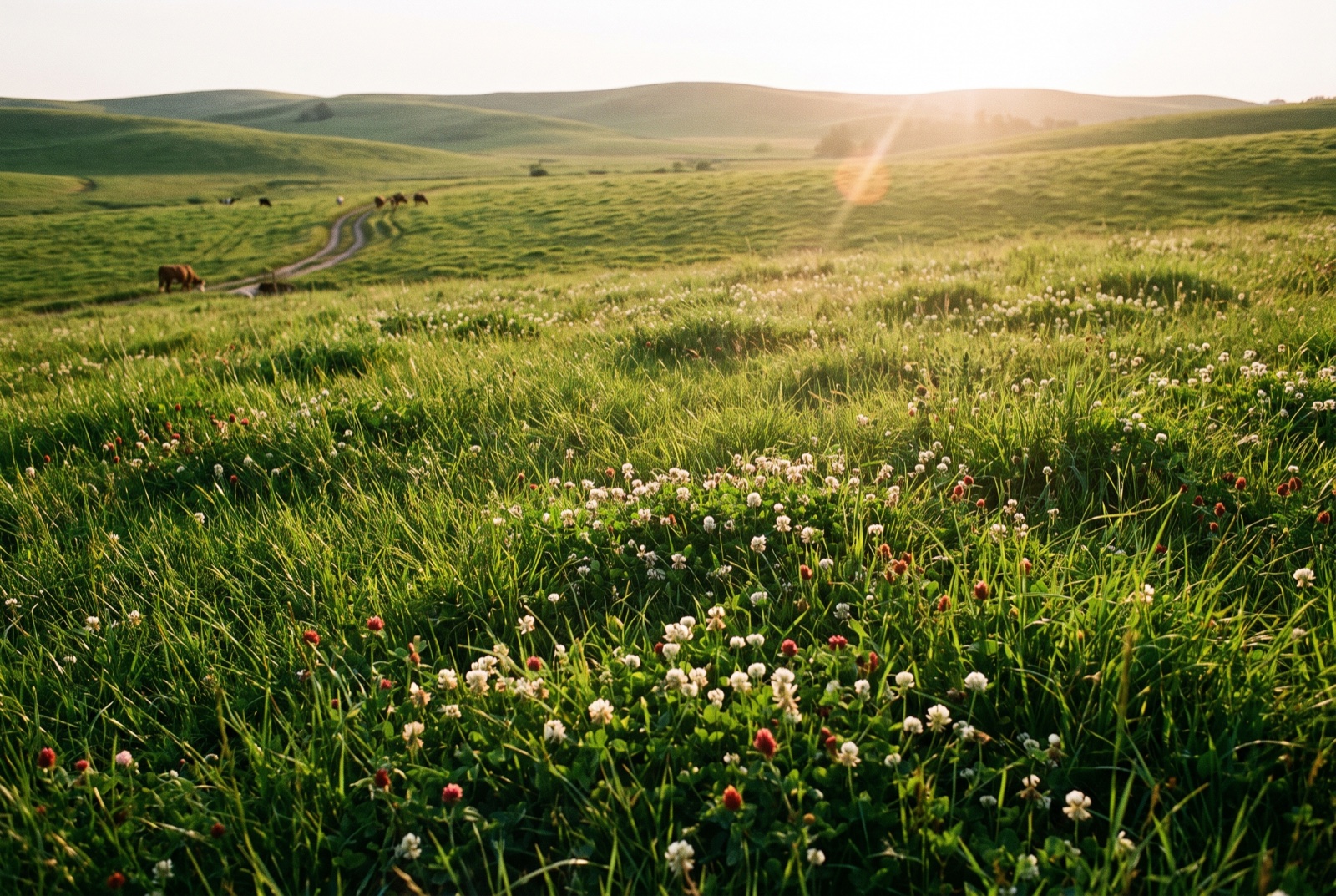
Every farm has a piece of ground nobody wants — rocky, sandy, thin, worn out, the corner where nothing grows and the fertilizer bill goes to die. Conventional thinking says you truck in amendments until it behaves, or you write it off.
There's a third option, and it's the one nature has always used: you grow the soil itself.
Every inch of deep, black soil on this continent was built from bare rock and sand by nothing more than plants, roots, animals, and time. That process isn't a mystery, and it doesn't have to be slow if you run it on purpose. The worst ground you own isn't a dead end. It's just a soil that hasn't been built yet.
Stop feeding the plants. Start growing a soil.
Rocky, sandy ground usually isn't short on minerals — they're locked up in the rock and the sand. What it's missing is life, and the organic matter that life runs on: the spongy, carbon-rich layer that holds water, stores nutrients, and feeds a crop. Dump fertilizer on it and you're renting a little growth that washes away by fall.
So change the goal. You're not trying to feed this year's plants. You're trying to build the living soil that will feed every plant after them.
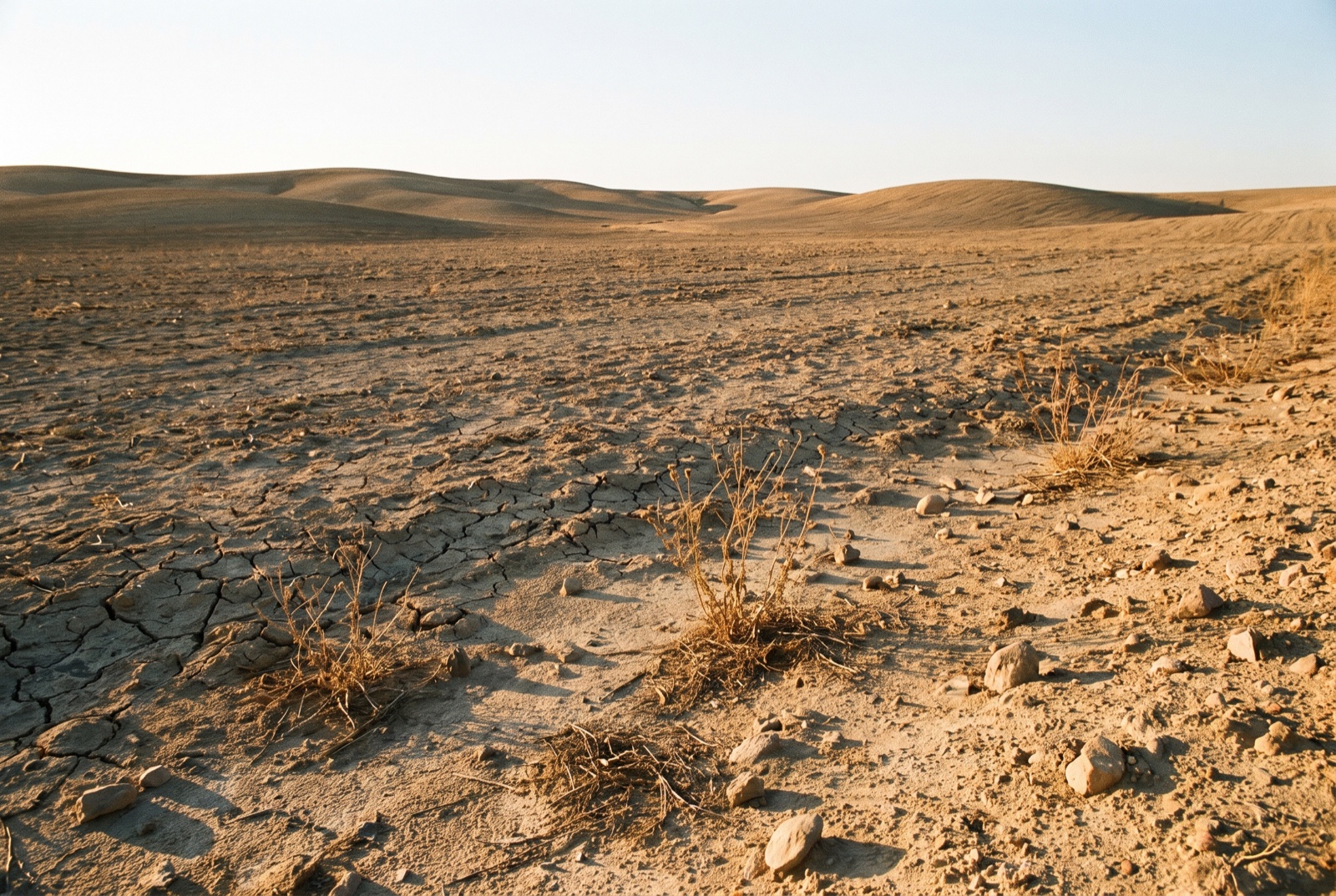
The starting line: rocky, sandy, depleted ground most people write off. Not a dead end — a soil that hasn't been built yet.
Start with cereal grains and annual grasses
The fastest way to build organic matter is to grow an enormous amount of it and give it straight back to the ground. On depleted, rocky, sandy soil, cereal grains and annual grasses are the workhorses — cereal rye, oats, triticale, wheat, barley. The seed is cheap, they'll germinate where almost nothing else will, and they throw down huge root systems and a wall of biomass in a single season. The biomass you can see; the part you can't is every one of those living roots pumping sugar into the ground, waking up the microbes and fungi that will become your soil's permanent workforce.
Crimp it into a mulch to grow through
Let the cover grow all the way to its peak, then — right at the soft-dough stage, when the grain has formed but isn't yet viable seed — roll it flat with a crimper. Timing is the whole game: too early and it stands back up; too late and it reseeds itself into next year's weed problem. Hit the dough stage and it terminates cleanly, no tillage and no spray, laying the whole crop down as a thick mat on the surface.
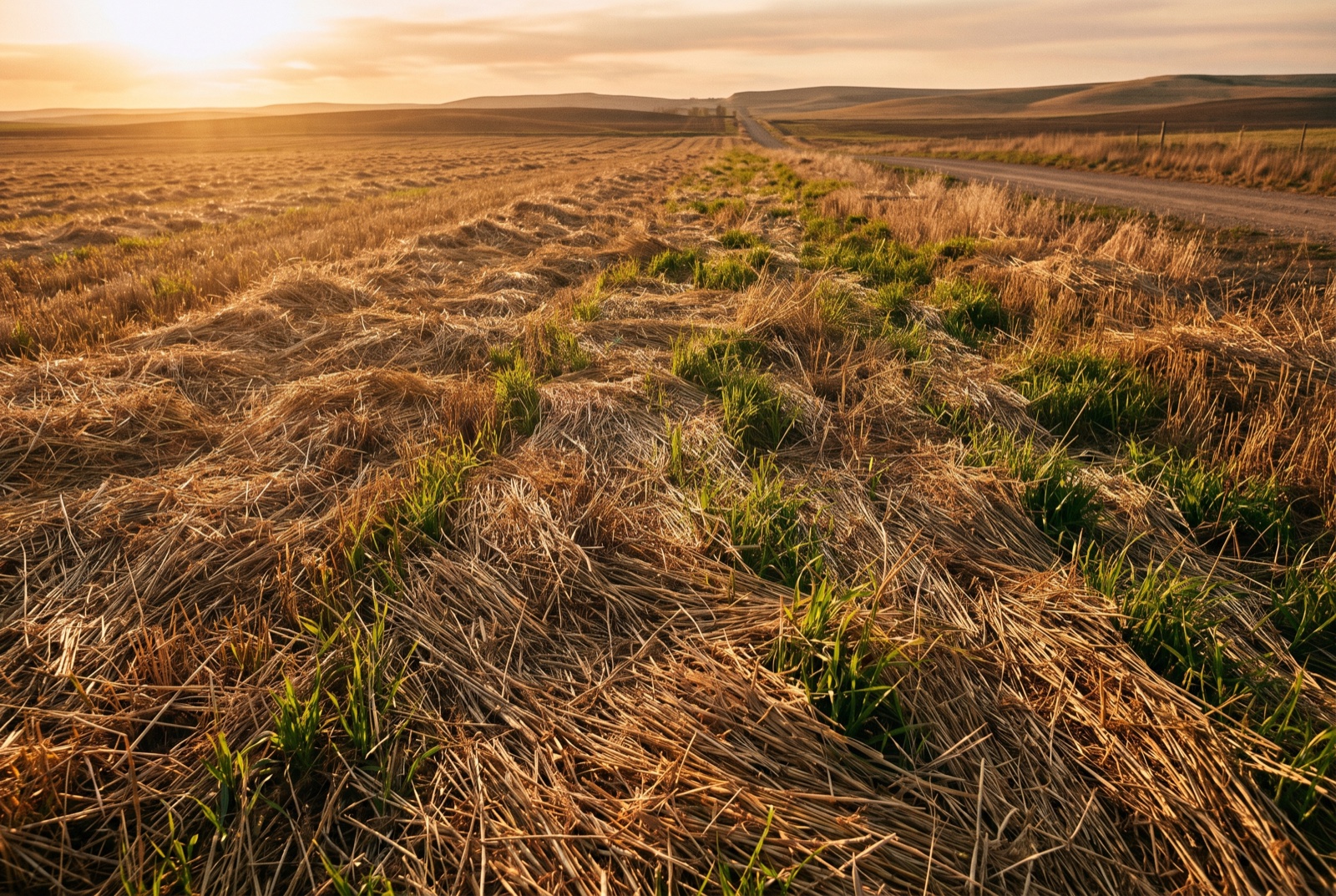
Cereal rye crimped flat at the dough stage — a moisture-holding mulch for the next crop to grow up through.
That mulch layer is the point. On horribly depleted ground, the real killer is that bare rock and sand can't hold water — seed cooks and germination fails. A crimped mat changes that overnight: it shades the surface, traps moisture underneath like a sponge, and gives your next crop something to grow up through instead of baking on exposed dirt. And as that mat breaks down, it kick-starts the organic decomposition cycle — the first real feeding the soil biology has ever had. Keep the ground covered, keep living roots in it, and never turn it over. Bare, tilled soil is soil going backward; a mulched, planted surface is soil coming to life.
Then plant the pasture you actually want
Now you establish the stand that will carry the farm — and this is where the legumes come in. Drill your perennial pasture mix straight through the mulch: grasses for bulk and deep root, and a strong legume component — clovers, alfalfa, vetch, trefoil — to pull nitrogen out of the air for free and feed the whole sward from within. The mulch holds the moisture that gets it germinated; the legumes supply the fertility that keeps it climbing. You're no longer fighting the dirt — you're growing into ground you built.
Open the ground and steer the water
With the pasture in, there's a mechanical job to keep up while it establishes — and it's the one the animals will eventually take over. Depleted ground is almost always compacted ground — a hard pan that sheds water and stops roots cold. So twice a year, spring and fall, you loosen it: aerate the surface to let air, water, and roots back in, and run a subsoiler deep enough to fracture that pan — without ever turning the soil over.
Here's the part that's pure good practice: run those subsoil lines perpendicular to the terrain — across the slope, on contour, never straight up and down it. Every rip line then becomes a shallow trench that catches rain where it lands, slows it down, and forces it to soak in instead of running off and cutting the hillside. You're not just loosening dirt — you're steering the whole watershed: holding water high on the land, recharging it into the ground, and stopping erosion before it starts.
And to be clear, this isn't the tillage we warned against. Turning soil over — flipping and pulverizing it — destroys the structure and biology you're working to build. A subsoiler does the opposite: it fractures the compaction deep down and opens vertical channels for water and roots while leaving the surface and the sward intact. One wrecks the soil; the other opens the door for it to heal.
You keep this up, spring and fall, until the pasture and its biology are strong enough for the animals to do the job themselves — because a well-managed herd is its own aeration machine. Every hoof presses seed and litter into contact, breaks the surface crust, and works air into the ground, then moves on before it does harm. The subsoiler and the aerator are stand-ins, doing the herd's work until the herd can safely take over.
Mow before you graze — for as long as it takes
Here's where patience pays, and it isn't one season. Before a single cow sets foot on it, you mow the young pasture — and you keep mowing it, across multiple seasons, until the perennial stand is deeply, powerfully rooted. Every cut drives the plants to tiller and root deeper, thickens the stand, and drops another round of clippings that feed the soil. You're not growing a salad bar yet; you're growing roots and biology, and a strong perennial establishment is worth waiting years for. Rush it and you spend the next decade with a weak, patchy stand. Build it and it carries the herd for a generation.
Why the wait matters: manure is only fertilizer on living soil
Put cattle on biologically dead ground and their manure doesn't fertilize anything — it burns. With no organic matter to absorb and buffer the load, the concentrated nitrogen in dung and urine scorches the very microbiome you're trying to build: a nitrogen burn on soil that has no reserves to take the hit. And a fresh patty dropped on bare, lifeless ground doesn't melt into the soil the way it should — it sits on top and smothers the spot underneath, sealing out the oxygen and turning it into a dead, anaerobic patch instead of feeding it. There are no dung beetles to bury it, no worms and fungi to pull it down and cycle it. What should be fertility becomes a scatter of dead spots and runoff.
Build the biology first — an established pasture with the worms, beetles, and fungi to match — and the exact same manure flips completely. Now every patty gets buried, digested, and turned into soil within days: the single best input on the farm, delivered and spread for free. The animal only becomes an asset once the ground is alive enough to use what it leaves behind. That's the whole reason for the patient order — cover crop, mulch, pasture, and seasons of mowing — before a single hoof lands.
Never leave excrement with food
There's one more rule that holds even after the soil is alive, and it's the one industrial agriculture breaks every single day: never make an animal eat where it defecates. Healthy animals don't graze standing in their own waste — wild herds never did. They eat, they move on, and they don't return until the ground has rested and the manure has cycled away. That's the entire logic of rotational grazing: keep the herd moving, keep excrement and feed separated in time and space, and the animals stay clean, parasite cycles break, and the pasture takes a pulse of fertility followed by a long rest.
Do the opposite — pack animals onto the same ground and force them to live in their own manure — and disease pressure never lets up. That's not a knock on the animals; it's just biology. And it's exactly why factory-farmed meat leans on constant antibiotics: when you keep excrement with food, you have to medicate around the sickness you've engineered. Good grazing doesn't need the drugs, because it never creates the problem. Move the animals, and manure goes back to being what it was always meant to be — food for the soil, not a threat to the herd.
The same story, from the ground up
This is where all of it begins. You didn't buy your way to fertility — you grew it, out of cheap seed, sunlight, roots, and a few seasons of patience, and turned the worst ground you owned into living pasture. It's the same lesson we keep coming back to: living soil does the work, and it's the organic matter you build that becomes the land's real worth. You just have to build it first — in the right order.